
Queue a task execution
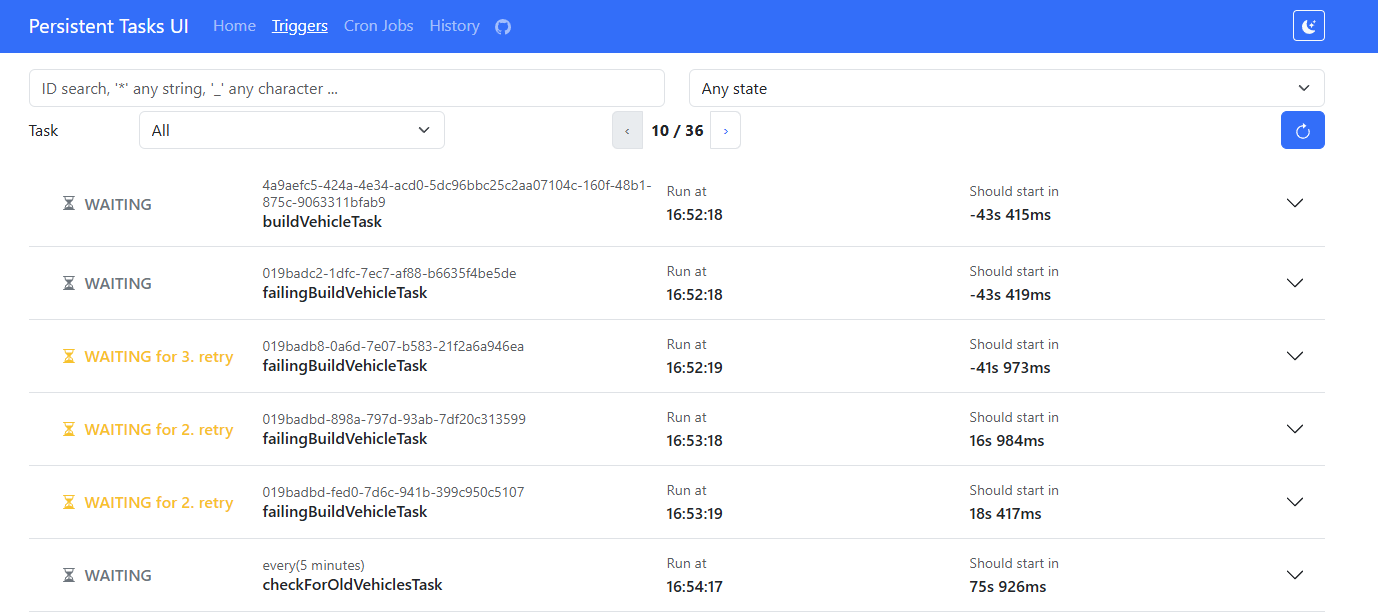
You can queue a task for later execution or request the executor to run a task directly if a free thread is available on the node.
Direct usage of the TriggerService or PersistentTaskService.
private final TriggerService triggerService;
private final PersistentTaskService persistentTaskService;

public void buildVehicle() {
    // Vehicle has to be Serializable
    final var v = new Vehicle();
    // set any data to v ...

    // EITHER: queue it - will always run later
    triggerService.queue(BuildVehicleTask.ID.newUniqueTrigger(v));

    // OR: will queue it and run it now if possible.
    // if the scheduler service is missing it is same as using the TriggerService
    persistentTaskService.runOrQueue(BuildVehicleTask.ID.newUniqueTrigger(v));
}Build complex Trigger
private final PersistentTaskService persistentTaskService;

public void buildVehicle() {
   var trigger = TriggerBuilder
            .<Vehicle>newTrigger("task2")
            .id("my-id") // will overwrite existing triggers
            .state(new Vehicle("funny"))
            .runAfter(Duration.ofHours(2))
            .build();

    persistentTaskService.runOrQueue(trigger);
}Priority
Use priority to let important work win the worker. Every trigger has a priority (0-9, higher is picked earlier — same idea as JMS). It defaults to TriggerRequest.DEFAULT_PRIORITY (4). When several triggers are due and a worker thread frees up, the engine picks the highest-priority waiting trigger next.
var trigger = TriggerBuilder
        .<Folder>newTrigger("index-folder")
        .id(folder.id())     // single-flight per folder
        .priority(1)         // below the default 4 → background, yields to other work
        .build();

persistentTaskService.runOrQueue(trigger);This matters most when worker threads are scarce (e.g. persistent-tasks.max-threads: 1, a single in-flight task at a time). Give long-running background jobs a low priority so latency-sensitive or short tasks are picked first. For example, a bulk re-indexing job set to priority(1) lets a freshly queued user-triggered task (default priority 4) jump ahead of any not-yet-started index work.
Priority orders, it does not preempt
A higher priority only decides which waiting trigger is picked next; it never interrupts a trigger that is already running. With a single worker, a long task already in flight still has to finish before the next one starts — so prioritise by keeping background units small and frequent rather than expecting them to be paused mid-run.
Using a Spring Application Event
private final ApplicationEventPublisher eventPublisher;

public void buildVehicle() {
    // Vehicle has to be Serializable
    final var v = new Vehicle();
    // send an event with the trigger inside - same as calling the PersistentTaskService
    eventPublisher.publishEvent(TriggerTaskCommand.of(BuildVehicleTask.ID.newUniqueTrigger(v)));
}